
Agentic AI, without the mystique.
“Agentic AI” has had a very fast journey from research paper to sales deck, and something got lost along the way. Depending on who you ask, an agent is either a mildly clever automation, a digital colleague, or an existential threat to the concept of employment.
It’s none of those. Here’s the plain version.
The one-sentence definition
A chatbot answers. An agent acts.
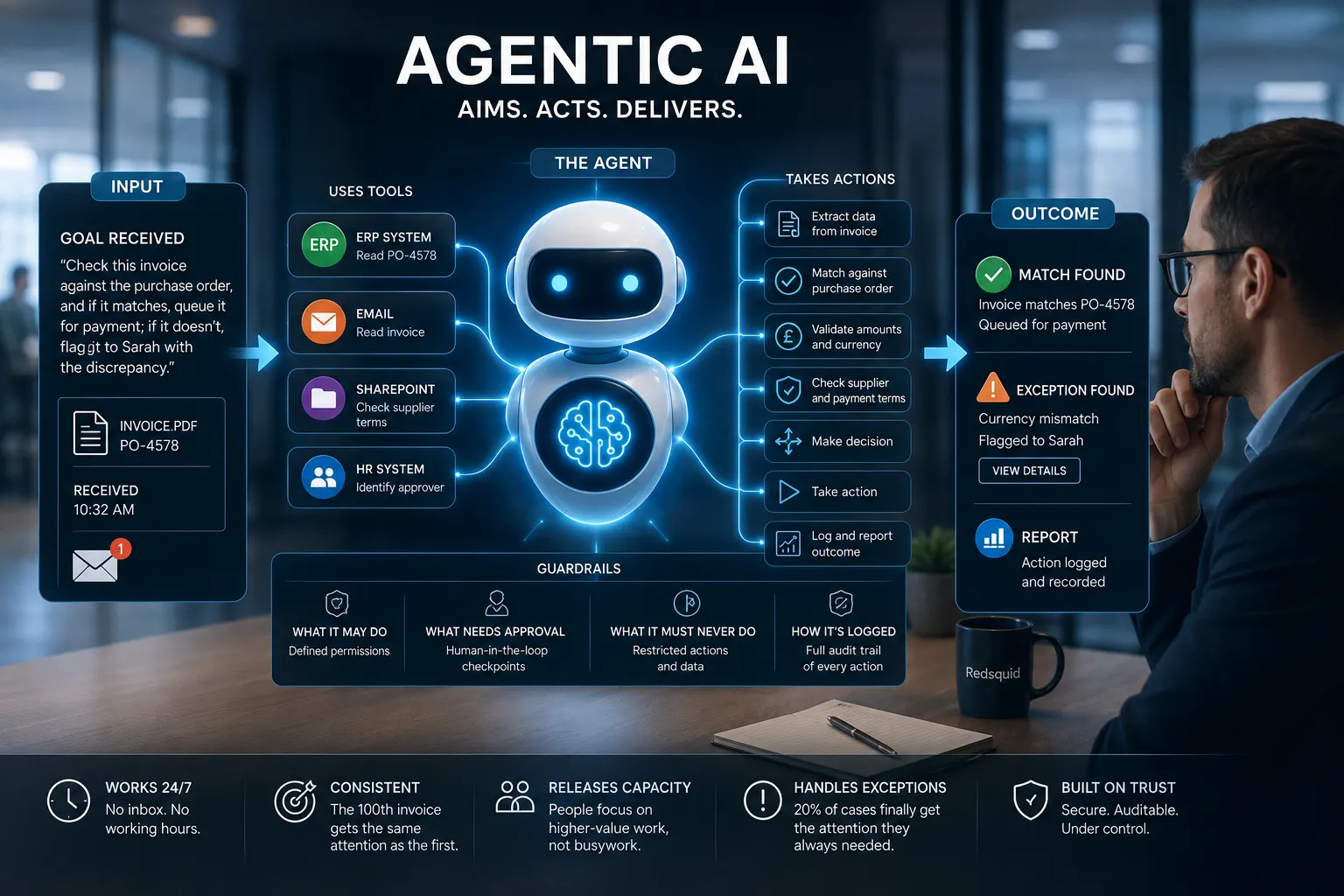
When you ask Copilot to summarise a document, it produces text and stops. When you give an agent a goal — “check this invoice against the purchase order, and if it matches, queue it for payment; if it doesn’t, flag it to Sarah with the discrepancy” — it takes multiple steps, uses tools, makes decisions along the way, and reports back.
That’s the whole distinction. An agent is an AI model that has been given a goal, access to some tools, and permission to take a sequence of actions without being prompted at each step.
Why it’s not just automation with better marketing
Fair challenge, and worth answering properly, because most SMBs already have automation and won’t thank you for renaming it.
Traditional automation is deterministic. You define every step and every condition in advance. If the invoice arrives in an unexpected format, the workflow breaks, and someone gets an error email.
An agent handles the cases you didn’t specify. It can read an invoice it hasn’t seen the layout of before, work out which field is the total, notice that the currency is wrong, and decide that’s worth escalating rather than guessing.
That flexibility is the entire value — and the entire risk. Deterministic automation fails loudly and predictably. Agents fail creatively. Which is why the guardrails matter more than the technology.
The three ingredients
Every agent worth deploying has three things. If a vendor can’t clearly describe all three, you’re being sold a demo.
A goal. Specific and bounded. “Reconcile supplier invoices against purchase orders” is a goal. “Improve our finance function” is a hope.
Tools. The systems it can read from and write to — your accounting platform, your CRM, your ticketing system, a mailbox, a SharePoint library. An agent with no tools is a chatbot. An agent with unrestricted tools is a liability.
Guardrails. What it may do alone, what needs a human to approve, what it must never touch, and how everything it does is logged. This is the part that gets skipped in demos and the part that determines whether the project survives its first mistake.
Where agents genuinely earn their place in a smaller business
Agents are worth it where work is high-volume, rules-based-but-messy, and currently eating someone’s week. Some realistic candidates:
Finance and admin. Invoice matching and coding, expense checking against policy, chasing purchase order discrepancies, preparing month-end packs. Repetitive, well-defined, and full of small variations that break traditional automation.
Customer service triage. Reading an incoming enquiry, classifying it, pulling relevant account history, drafting a response, and routing anything unusual to a person with context attached. The agent doesn’t replace your service desk; it removes the twenty minutes of gathering that precedes every reply.
Sales operations. Enriching new leads, keeping CRM records current, preparing pre-meeting briefs from email and meeting history, flagging accounts that have gone quiet. Work everybody agrees should happen and nobody has time for.
IT and service management. Handling routine requests end to end — access provisioning within defined policy, password resets, software requests, first-line diagnostics with escalation when the pattern isn’t recognised.
Reporting. Pulling numbers from several systems, assembling the recurring report, highlighting variances, flagging anything that looks wrong. The monthly ritual that takes a day and a half.
Notice what these share: a clear unit of work, an existing manual process, and a defined point at which a human takes over. That’s the profile to look for.
Where agents are the wrong answer
Be equally clear about this, because deploying an agent into the wrong process is how organisations conclude that AI doesn’t work.
- Anything where a wrong decision is expensive and hard to reverse. Payments leaving the business, contractual commitments, HR decisions, anything with a regulator attached.
- Processes that are already broken. An agent will execute your bad process faster and more consistently. Fix it first.
- Work that depends on relationships. Difficult client conversations, negotiation, anything where the point is that a person cared enough to do it.
- Anything you can’t audit. If you couldn’t explain to a customer or an auditor what happened and why, don’t automate it.
What you need in place first
This is the part that determines success, and it’s rarely about AI at all.
Clean permissions. An agent inherits the access it’s given. If your file structure has accumulated a decade of over-sharing, an agent will find it — and act on it. Permissions review comes before deployment, not after.
Identity and access control. Agents should have their own identities, scoped narrowly, with credentials managed like any other privileged account. An agent running on a shared admin login is an audit finding waiting to happen.
Logging and human checkpoints. Every action recorded. Clear thresholds where a human approves before anything commits. Start with approval on everything and relax it as confidence builds — the reverse is much harder to do calmly.
Data quality. Agents make decisions from your data. Duplicate customer records, stale pricing and half-finished CRM fields become decisions, not just annoyances.
A named owner. Someone accountable for what the agent does, who reviews its output weekly at first. Unowned agents drift.
The outcomes to expect
Realistically, on a well-chosen first process:
- Elapsed time collapses. Work that queued overnight now completes in minutes, because agents don’t have working hours or an inbox to get through first.
- Consistency improves. The hundredth invoice gets the same attention as the first. Consistency, rather than raw speed, is often where the quality gain shows up.
- Capacity is released, not headcount. In smaller organisations, the honest outcome is usually that the finance manager stops spending Thursdays on reconciliation and starts doing the analysis nobody has had time for.
- Exceptions get better treatment. When 80% of routine cases handle themselves, the awkward 20% finally get the attention they always needed.
What you shouldn’t expect: an agent that runs unsupervised from week one, or a business case that works without fixing something underneath first.
Start small, on purpose
The pattern that works: one process, one agent, tight scope, human approval on every action, four to six weeks of close observation, then widen the remit. It feels slow. It is considerably faster than the alternative, which is a broad deployment that gets switched off after one visible mistake and takes eighteen months to get board approval again.
How Redsquid approaches this
We assess agentic AI opportunities the same way we assess anything else touching your environment: what’s the process, what access does it require, what could go wrong, and what does the audit trail look like. Because agents need identity, permissions, data and monitoring to be right, this work sits naturally across Managed AI, Managed Technology and Managed Cybersecurity rather than in a silo.
Want to know whether agentic AI fits a process in your business? Book a readiness conversation.